Index
- Introduction
- Diatom research
- Virtual type collection and supplementary data and images supporting published work
Introduction
The mission of the Royal Botanic Garden Edinburgh is to
"explore and explain the world of plants" and we seek to
fulfil this aim with respect to algae, focusing on two groups: diatoms
and green algae. Our interests are broad and include cell biology,
morphogenesis and ecology, but we publish mostly in the fields of
systematics and evolution, speciation, biogeography and taxonomy.
Diatom research
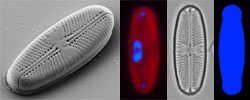
Our current research predominantly focuses on the genus Sellaphora, a group of mud-dwelling diatoms that is found throughout the world’s lakes, ponds and rivers. For more than two decades we have studied Sellaphora, originally in Blackford Pond, an ordinary duck pond in Edinburgh and, more recently, in more distant ponds in England, Belgium, Czech Republic and Australia. Over the years we have gathered a wide variety of data that demonstrate the existence of hidden or cryptic diversity in diatoms. The “species” we have studied in most detail has been Sellaphora pupula, a common epipelic diatom. We have demonstrated that this traditionally defined species is in fact composed of many 10s of species, for example in Blackford Pond alone, nine different S. pupula species live alongside each other. Detailed investigations have shown that these species usually (but not always!) differ slightly in their shape and pattern, that individuals belonging to different species rarely if ever interbreed, and that different species possess distinct DNA sequences.
The high levels of cryptic diversity in diatoms can make them difficult to identify. Consequently, we have increasingly turned to DNA-based methods (including “DNA barcoding”) in our efforts to understand more about diatoms.
Some of our key research questions are:
- How many diatom species are there?
- Do diatom species possess biogeographies?
- How much dispersal and hence gene flow occurs between diatoms living in different ponds?
- Do cryptic species possess different ecologies?
- Should scientists who use diatoms as indicators of environmental conditions adopt a finer species concept?
You will find links to pages that explore these areas of research
further. In particular, please visit the 'Sellaphora' pages.