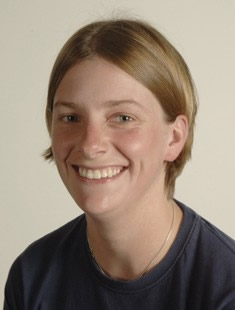
Dr Katharine Evans (NERC Research Fellow 2005-2010)
Brief CV
- 2005-2010 NERC Postdoctoral Fellow, Royal Botanic Garden Edinburgh
- 2004-2005 Postgraduate Certificate in Education (PGCE), University of Bristol
- 2001-2004 NERC Post-doctoral researcher, School of Biological Sciences, University of Bristol
- 1997-2001 Ph.D., School of Botany, University of Melbourne
- 1993-1996 First Class BA (Hons.) in Natural Sciences, University of Cambridge
Research
In my NERC Fellowship, I focused on two “hot topics” in microbial research: bar-coding for identification and biogeography.
- What is a microbial species?
- Do microbes possess biogeographies?
- Model system: Sellaphora pupula
- To whom is this research relevant?
What is a microbial species?
A growing body of evidence, i.e. the discovery of cryptic species, suggests that the current morphospecies approach to microbial studies is too coarse; instead a narrower species concept should be adopted. Recently, a DNA barcoding system was proposed, whereby all taxa (not just microbes) would be classified and identified according to sequences of certain target genes. Although DNA barcoding has been supported strongly by its proponents, there are also many sceptics. I tested this system rigorously by assessing the degree of correspondence between molecularly and biologically (morphological and breeding data) defined taxa of semi-cryptic diatoms, principally using the Sellaphora.model system (see below).
Do microbes possess biogeographies?
It has been proposed in various articles, including in Science
and Nature, that all microbes are cosmopolitan,
thus differing fundamentally from plant and animal species. The number
of microbial species is therefore proposed to be relatively low and
speciation and extinction rates are assumed to be rare. A problem with
this hypothesis is that it is based on
“morphospecies,” a potentially unsafe approach
because of the high incidence of cryptic species. I tested this
ubiquitous dispersal hypothesis stringently by analysing the genetic
structure of
populations of Sellaphora capitata;
if
microbial species really are dispersed widely, then there should be
little, if any, genetic differentiation between widely separated
populations of this cosmopolitan species. My studies, using
microsatellite markers, demonstrated that differentiation does exist,
though the relationship between genetic and geographical distances is
not simple.
Model system
Prof. David Mann has established Sellaphora pupula agg. as a model system for studying the nature of species in diatoms. Intensive studies by Mann and colleagues have demonstrated the existence of a large number of semi-cryptic species within this species complex, thus providing a unique basis for microbial biogeography and population genetic studies.
To whom is this research relevant?
This research is relevant to a wide variety of people, including, environmental scientists, who use diatoms to assess water quality; palaeoecologists and climate scientists, who use diatoms to reconstruct past environments; taxonomists; and biogeographers.